Historical Landmark Exploration Log: A Traveler’s Guide to the World's Most Iconic Sites
The Historical Landmark Exploration Log serves as a valuable resource for anyone passionate about history, travel, or cultural discovery. This comprehensive guide offers insights into some of the world's most remarkable sites, from ancient ruins to modern marvels. Whether you're planning a vacation, conducting research, or simply curious about the past, this log provides a structured approach to documenting and understanding historical landmarks.
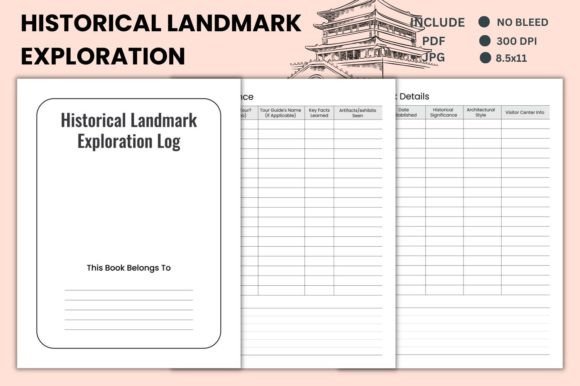
Designed with both practicality and aesthetics in mind, the log includes 120 pages of content, formatted in high-resolution JPG and PDF files at 300 dpi. These files are print-ready and sized for 8.5" x 11", making them ideal for use on platforms like Amazon KDP. The absence of a bleed ensures that the layout remains clean and professional when printed or uploaded digitally.
Exploring Key Destinations Around the Globe
The Historical Landmark Exploration Log covers a wide range of locations, offering detailed entries on famous places across different continents. From the Colosseum in Rome to the Great Wall of China, each entry is crafted to provide travelers and students with essential information about the site's history, significance, and visitor experience.
- Rome, Italy: The Colosseum stands as a testament to ancient Roman engineering and entertainment culture. Visitors can explore its vast arena and learn about gladiatorial games that once captivated crowds.
- China, East Asia: The Great Wall of China is one of the most iconic structures in the world. The log includes details on its construction, historical role, and best times to visit.
- Africa: The pyramids of Egypt remain a symbol of ancient civilization. Entries in the log describe their architectural features and the mysteries surrounding their purpose.
- Brazil: The Christ the Redeemer statue in Rio de Janeiro is a prominent landmark. The log highlights its cultural and religious significance, as well as the views it offers from its location atop Corcovado Mountain.
These examples illustrate how the log caters to a diverse audience, including tourists, educators, and researchers who seek to deepen their understanding of global heritage sites.
Features and Benefits of the Historical Landmark Exploration Log
The log is more than just a collection of facts—it is a tool designed to enhance the travel experience. Its structure allows users to track their journeys, record observations, and reflect on their encounters with history. This makes it particularly useful for those who enjoy keeping a travel diary or a personal organizer.
One of the standout features of the log is its versatility. It can be used as a handbook, a picture book, or even a hardcover book, depending on the user's preference. The high-resolution images included ensure that every detail of a landmark is captured clearly, making it an excellent reference for educational purposes.
For professionals such as tour guides or historians, the log serves as a reliable source of information that can be shared with clients or students. Its organized format also makes it ideal for business owners looking to create engaging content for travel-related products or services.
Practical Applications of the Log
The Historical Landmark Exploration Log has numerous real-world applications. For hobbyists and travelers, it functions as a planner, helping them organize their visits to various sites. Each page is designed to accommodate notes, sketches, or reflections, allowing users to personalize their experience.
Educators can utilize the log in classrooms to teach students about geography, history, and cultural studies. The inclusion of vector graphics and clear descriptions makes it easier to explain complex concepts in an engaging way. Additionally, the log can be used as a supplement to traditional textbooks, providing a more interactive learning experience.
Researchers and writers may find the log helpful for gathering data or inspiration. By referencing the detailed entries on different landmarks, they can develop a deeper understanding of historical contexts and trends. The log also encourages critical thinking by prompting users to compare and contrast different sites based on their features and significance.
Choosing the Right Format for Your Needs
The log is available in multiple formats, ensuring that it can be accessed and used by a wide range of individuals. The JPG and PDF versions allow for easy sharing, printing, or digital storage, while the 300 dpi resolution guarantees clarity and quality. Users can choose the format that best suits their workflow, whether they prefer a physical copy or a digital version.
For those interested in creating a personalized travel journal, the log offers a flexible structure that can be adapted to individual preferences. The 8.5" x 11" size is ideal for kdp uploads, making it a convenient option for authors and content creators looking to publish their work online.
The log's design also takes into account the needs of modern travelers, who often rely on technology to plan and document their trips. By integrating digital elements with traditional journaling, it bridges the gap between old and new ways of exploring the world.
Enhancing the Travel Experience Through Documentation
Keeping a record of one's travels can be a rewarding experience, and the Historical Landmark Exploration Log provides the tools needed to do so effectively. By encouraging users to observe, reflect, and document their experiences, it transforms a simple journey into a meaningful exploration of history and culture.
This approach not only enhances the traveler's understanding of a place but also creates a lasting memory. The log's structured format ensures that each visit is documented in a way that is both informative and visually appealing. Whether used as a personal organizer or a study guide, it adds value to any travel-related endeavor.
As more people seek to connect with the past through travel, resources like the Historical Landmark Exploration Log play an important role in preserving and sharing knowledge. By combining education with practical application, it supports a deeper appreciation for the world's historical landmarks.